Get Certified for Financial Modeling (FMVA)®
Gain in-demand industry knowledge and hands-on practice that will help you stand out from the competition and become a world-class financial analyst.
The minimum rate of return that a business must earn before generating value
Cost of capital is the minimum rate of return that a business must earn before generating value. Before a business can turn a profit, it must at least generate sufficient income to cover the cost of the capital it uses to fund its operations. It consists of both the cost of debt and the cost of equity used for financing a business.
A company’s cost of capital depends, to a large extent, on the type of financing the company chooses to rely on – its capital structure. The company may rely either solely on equity or solely on debt or use a combination of the two.
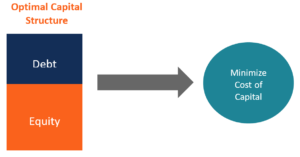
The choice of financing makes the cost of capital a crucial variable for every company, as it will determine its capital structure. Companies look for the optimal mix of financing that provides adequate funding and minimizes the cost of capital.
In addition, investors use the cost of capital as one of the financial metrics they consider in evaluating companies as potential investments. The cost of capital figure is also important because it is used as the discount rate for the company’s free cash flows in the DCF analysis model.
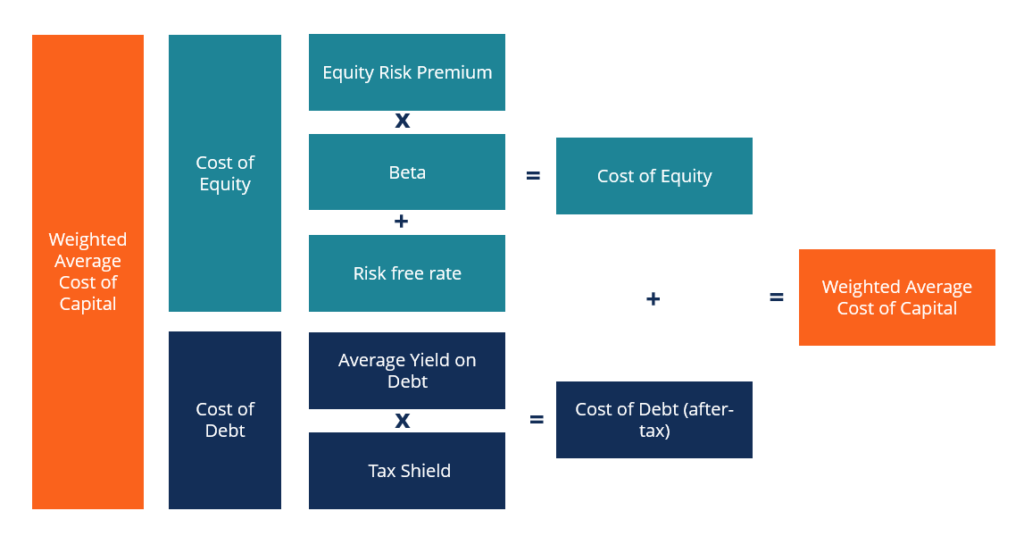
The most common approach to calculating the cost of capital is to use the Weighted Average Cost of Capital (WACC). Under this method, all sources of financing are included in the calculation, and each source is given a weight relative to its proportion in the company’s capital structure.
WACC provides us with a formula to calculate the cost of capital:

The cost of debt in WACC is the interest rate that a company pays on its existing debt. The cost of equity is the expected return on the company’s shareholders’ investment.
Cost of capital is an important factor in determining the company’s capital structure. Determining a company’s optimal capital structure can be a tricky endeavor because both debt financing and equity financing come with advantages and disadvantages.
Debt is a cheaper source of financing compared to equity. Companies can benefit from their debt instruments by expensing interest payments on existing debt, thereby reducing taxable income. These reductions in tax liability are known as tax shields. Tax shields are crucial to companies because they help preserve cash flows and the company’s total value.
However, at some point, the cost of issuing additional debt will exceed the cost of issuing new equity. For a company with a lot of debt, adding new debt will increase its risk of default and its inability to meet its financial obligations. A higher default risk will increase the cost of debt, as new lenders will demand a premium to compensate for the higher risk.
In addition, a high default risk may also drive the cost of equity up because shareholders will likely expect a premium over and above the rate of return for the company’s debt instruments for taking on the additional risk associated with equity investing.
Despite its higher cost (equity investors demand a higher risk premium than lenders), equity financing is attractive because it does not create a default risk to the company. Also, equity financing may be easier to raise large amounts of capital, especially if the company does not have extensive credit with lenders. However, for some companies, equity financing may not be a good option, as it reduces current shareholders’ control over the business.
CFI wants to help you become a world-class financial analyst and advance your career. With that goal in mind, feel free to explore the following resources: